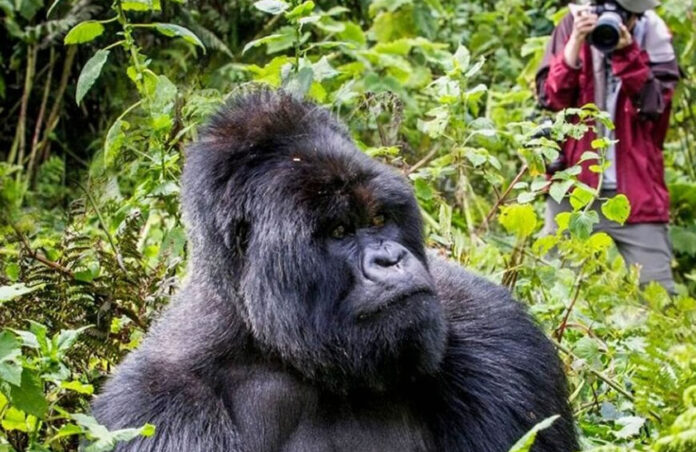
Uganda is unveiling new tourism products for travellers to the southwestern part of the country, a region that has hitherto been widely known for mountain gorilla trekking in the country’s Bwindi Impenetrable and Mgahinga Gorilla national park.
Nicknamed the Switzerland of Africa, southwestern Uganda is arguably the most beautiful part of Uganda.
The region is home to many of the country’s most fascinating tourist attractions, including the iconic mountain gorillas, historic caves, some of the world’s most beautiful lakes (such as Lake Bunyonyi and Lake Mutanda), volcanic mountains, and a variety of flora and fauna.
In fact, it is said that it was while he was standing at the summit of Kanaaba Hill in southwestern Uganda’s Kisoro district that Winston Churchill declared Uganda the “Pearl of Africa”.
Kanaaba Hill offers clear, spectacular views of the beautiful rolling hills in the region, including all the eight Virunga volcanoes, some of which are located in neighboring Rwanda and the Democratic Republic of Congo (DRC).
The new tourist attractions in Kisoro are being developed by the Mgahinga Cultural and Crafts Centre, a Kisoro-based nonprofit that is working under the auspices of the Uganda Tourism Board, the country’s tourism industry regulator.
In this article, we unpack some of the new tourist attractions in Kisoro, southwestern Uganda:
• Caldera expeditions
• Mountain biking
• Caving
• Churchill Point
Churchill Point
You should have known by now that Uganda is referred to as the Pearl of Africa and that this term was coined by Winston Churchill more than 100 years ago.
But perhaps what you don’t know is how Churchill came to the conclusion that Uganda was the Pearl of Africa.
Well, Kanaaba Hill, located in Echuya Forest Reserve in Kisoro district, was the reason Churchill came to this conclusion.
As he stood at the summit of this hill, Churchill was fascinated by the magnificent natural beauty in front of him: beautiful rolling hills stretching into infinity, the natural wonder that is the Echuya Forest Reserve (formerly known as Echuya Bamboo Forest and stretches from Lake Bunyonyi in Kabale district to Mgahinga Gorilla National Park in Kisoro district), as well as the eight volcanic mountains that brood in a distance – some of which are located in neighbouring Rwanda and the Democratic Republic of Congo.
Now that this spot has been packaged as a bona fide, historic attraction (Churchill Point), visitors to southwestern Uganda can now follow in the footsteps of Churchill and rediscover the Pearl of Africa.
Caldera expeditions
In case you’re wondering what a caldera is, it’s a large crater caused by the violent explosion of a volcano that collapses into a depression.
Travellers to southwestern Uganda will now enjoy some of the best nature walks Uganda has to offer.
As you trek the calderas, you’ll not only be enchanted by the beautiful scenery of Kisoro district, but you’ll also enjoy riveting cultural encounters with locals tending to their gardens.
Mountain biking
Mountain biking fans have been taken care of following the recent introduction of Gorilla Bikes, courtesy of Ultimate Cycling Uganda. Three trails have so far been mapped in Kisoro district.
The Mgahinga Trail is 60 kilometres long and takes riders from the Mgahinga Cultural and Crafts Centre to the Mgahinga Gorilla National Park gate to the DR Congo and Rwanda borders and back to Mgahinga Cultural and Crafts Centre via Kisoro town.
The 80-kilometre Icyuya Trail starts from the scenic Lake Bunyonyi in Kabale district and goes through Kacyekano, Muko, Icyuya and ends at Churchill Point.
The longest is the Bwindi Trail, which begins from Kabale town and goes through Bwindi Forest, Mutanda and ends at the Mgahinga Gorilla National Park.
Caves
Caving expeditions are not entirely new in Kisoro, as there is already one cave – the 342-kilometre long, bat-infested Garama Cave – which has been open to tourists since a few years ago.
Now the Mgahinga Cultural and Crafts Centre has packaged two more caves for travellers to the area.
Sooko Cave is located at the foothill of Mount Mgahinga while Ruhengo is located at the foothill of Mount Sabinyo. The Mgahinga Cultural and Crafts Centre has already acquired caving equipment and also trained guides who are now on hand to help travellers unlock the secrets of these caves which, thousands of years ago, were a safe haven for those fleeing tribal wars.
These caves are estimated to be thousands of years old, according to Herbert Mugisha, head of Mgahinga Cultural and Crafts Centre.